What Is First Isaiah: Rhetoric, Narrative Flow, and Social Crisis in Isaiah 1–39
First Isaiah, usually understood as Isaiah 1–39, is not a loose anthology of prophetic sayings that can be reduced to a few famous prooftexts. It is a demanding literary work shaped by courtroom summons, satire, song, lament, sign-act, imperial parody, royal narrative, and visions of Zion’s collapse and renewal. Its rhetoric teaches readers how to hear. Its narrative flow moves from Judah’s moral disorder to the pressure of empire, from social critique to political trust, from the exposure of Jerusalem’s leaders to the possibility of a remade people. Its socio-historical setting is the world of eighth-century Judah: an agrarian society under stress, an urban elite enriched by trade and state centralization, and a small kingdom forced to navigate the ambitions of Assyria, Egypt, Philistia, Syria, Israel, and Babylon. For seminarians, ministers, lay leaders, teachers, and serious students of the Bible, First Isaiah offers a powerful account of how public worship, economic practice, political calculation, and theological imagination belong together.
Greg Camp and Patrick Spencer
5/28/202628 min read
Key Takeaways
1. First Isaiah trains readers to hear before it asks them to interpret. The opening summons, repeated “Hear!” commands, vineyard song, and call narrative make perception itself a theological issue. Readers are trained to recognize the habits that make communities deaf to God, neighbors, and danger.
2. The book’s narrative flow moves from Zion’s indictment to Zion’s possible renewal. Isaiah 1–39 does not simply announce disaster; it repeatedly stages the tension between judgment and restoration. Zion is exposed, threatened, purified, and reimagined as a place where divine instruction and public justice can again take root.
3. First Isaiah is deeply political without being reducible to politics. The book speaks into the decisions of kings, diplomats, landholders, judges, prophets, and priests while interpreting those decisions under the LORD’s sovereignty. Its central political question is trust: whether Judah will secure itself through panic, pride, and alliances or learn to live under the rule of the Holy One.
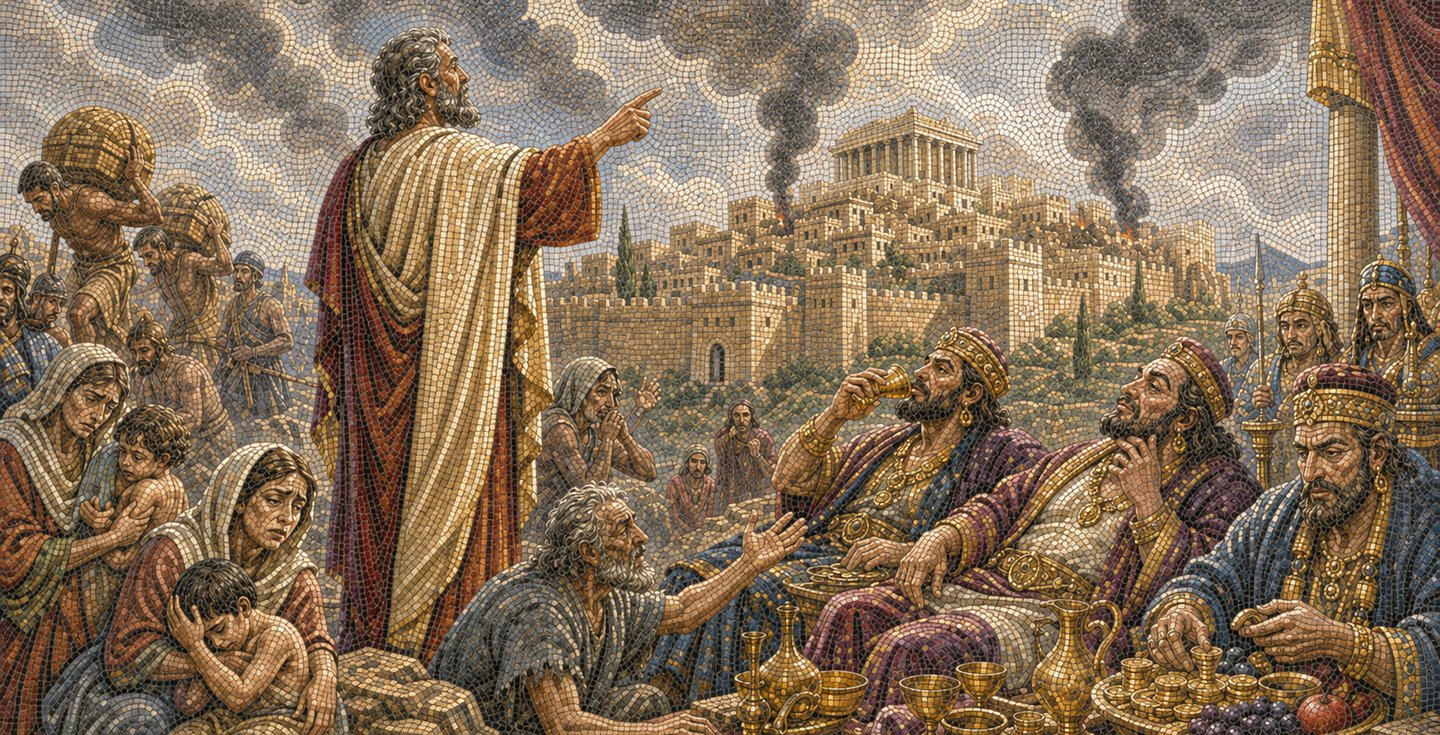
4. The rhetoric of First Isaiah exposes systems through images. Diseased bodies, ruined vineyards, arrogant trees, devouring fire, drunken priests, hidden plans, and carved tombs make social disorder visible. Isaiah’s metaphors are not decorative; they force readers to see how public injustice, hollow worship, and imperial arrogance deform ordinary life.
5. First Isaiah should be read and taught as a whole movement. Famous passages such as Isaiah 6, 7:14, 9:1–7, 11:1–9, and 35:1–10 gain sharper meaning when they are read within the larger drama of judgment, trust, and hope. Teachers should connect individual texts to the book’s unfolding argument rather than extracting them as isolated quotations.
What Is First Isaiah?
“First Isaiah” is the traditional shorthand for Isaiah 1–39. The label is useful, but it can mislead. It may sound as though these chapters are a self-contained book by a single author, followed by two unrelated books called “Second Isaiah” and “Third Isaiah.” Contemporary scholarship is more careful. The book of Isaiah is a long, complex, and carefully transmitted prophetic scroll. It contains older materials, later expansions, thematic links, and editorial shaping. Scholars continue to debate the formation of the book, but there is broad agreement that Isaiah 1–39 is anchored in the world of Judah under Assyrian pressure, even if some passages were shaped, supplemented, or reread in later periods.[1]
That matters for how the book is taught. First Isaiah should not be flattened into either a biography of Isaiah of Jerusalem or a disconnected library of later religious reflections. It is better approached as a prophetic composition whose literary form preserves memory, argument, judgment, hope, and rereading. It is both historically situated and theologically expansive. It speaks to eighth-century crises, but it also teaches later communities how to recognize the patterns by which power deceives, worship becomes hollow, and public life loses its moral center.[2]
The opening chapters already show this complexity. Isaiah 1 begins as a cosmic lawsuit: heaven and earth are summoned as witnesses against a rebellious people. Isaiah 2–4 then juxtaposes an exalted vision of Zion, where nations stream to receive instruction, with a sustained critique of pride, militarization, wealth, and elite display. Isaiah 5 turns Judah into a vineyard that produced violence instead of justice. Isaiah 6, placed after those opening indictments, narrates the prophet’s encounter with the Holy One and the difficult commission to speak to a people who will hear without understanding. The arrangement is not accidental. Before readers meet Isaiah in the temple, they have already heard the case against the society to which he is sent.
This is why the rhetoric of First Isaiah cannot be separated from its narrative flow. The book makes readers experience the problem before it explains the messenger. It opens not with a prophet’s résumé but with a damaged relationship: children have rebelled, the land is desolate, rulers are corrupt, worship is offensive, and Zion has become a place where justice once lodged but now murderers dwell. Only after that does the prophet stand before the throne. The sequence trains the audience to ask the right question. Not “Who is Isaiah?” first, but “What kind of people have we become, and what would it take to hear truthfully?”
The Rhetoric of Hearing: How First Isaiah Forms Its Readers
First Isaiah repeatedly commands its audience to hear. That command is more than an opening formula. It is the book’s basic pedagogy. “Hear, O heavens, and listen, O earth” (Isa 1:2) enlarges the courtroom beyond Jerusalem. Heaven and earth become witnesses because Judah’s crisis is not merely administrative or local. It is a rupture in the moral order of creation. The audience is forced to listen in the presence of the cosmos.
The irony, of course, is that hearing becomes the very thing Judah cannot do. Isaiah 6:9–10 famously commissions the prophet to speak to a people who “keep listening” but do not comprehend and “keep looking” but do not understand. The passage is often treated as a theological puzzle about hardening. Within the literary flow of First Isaiah, however, it functions as a diagnosis of public perception. The people have eyes and ears, but their social world has trained them not to recognize what is in front of them. Ritual continues. Diplomacy continues. Economic expansion continues. Temple language continues. But hearing has collapsed.[3]
This rhetoric has deep scriptural resonance. Isaiah 1:2–3 echoes language associated with Moses and covenantal witness, while Isaiah 6 replays motifs of divine encounter, unclean speech, commission, and the fearsome holiness of God. The effect is to present Isaiah not as a freelance critic but as a prophetic teacher whose speech continues the demands of divine instruction. The Torah-shaped atmosphere is important for ministers and teachers. Isaiah is not opposed to instruction; he is opposed to a society that can preserve religious forms while becoming deaf to the ethical force of divine instruction.[4]
The book also forms readers by using unsettling metaphors. Judah is a rebellious child, a sick body, an abandoned hut, a prostitute city, a vineyard gone wild, a forest to be burned, a drunk priest staggering at judgment, and a potter’s vessel arguing with its maker. These images do not decorate the argument. They carry it. They force readers to see moral disorder in bodily, agricultural, architectural, and political terms. The prophetic word becomes a disciplined act of re-description.
That rhetorical re-description is one reason First Isaiah remains powerful for teaching. Abstract phrases such as “social injustice,” “idolatry,” or “lack of trust” can remain too vague. Isaiah makes them visible. Injustice is not merely “bad behavior”; it is a vineyard that has produced bloodshed instead of justice. Political arrogance is not merely “poor leadership”; it is a tree so tall it imagines it can stand before the Holy One. Hollow worship is not merely “insincerity”; it is hands spread in prayer while stained with blood. The rhetoric presses interpretation into the senses.
Narrative Flow: From Zion’s Indictment to Zion’s Future
The narrative flow of First Isaiah can be read as a series of movements rather than as a straight chronological story. The book’s first movement, Isaiah 1–12, establishes the moral, theological, and political crisis of Judah and Jerusalem. The second movement, Isaiah 13–23, expands the horizon to the nations and shows that Judah’s crisis unfolds in a world of empires and fragile states. The third movement, Isaiah 24–27, lifts the vision to a more cosmic and liturgical register, imagining judgment, feast, death’s defeat, and the gathering of scattered peoples. The fourth movement, Isaiah 28–33, returns to the concrete politics of Jerusalem, exposing drunken leadership, false security, hidden counsel, and reliance on Egypt. The fifth movement, Isaiah 34–39, brings judgment and salvation into a narrative frame, culminating in Sennacherib’s threat, Jerusalem’s deliverance, Hezekiah’s illness, and the ominous Babylonian embassy.
This flow matters. First Isaiah repeatedly alternates judgment and hope, local accusation and international horizon, poetic oracle and narrative scene. It does not allow readers to settle comfortably into one mode. A vision of peace may be followed by humiliation of the proud. A promise of a Davidic ruler may stand next to the devastation caused by political rebellion. A hymn of trust may be surrounded by warnings against false alliances. This arrangement creates the theological pressure of the book.
Isaiah 1–12 is the foundation. Its dominant question is whether Zion can become what it is called to be. Isaiah 2:2–4 imagines Zion as a teaching mountain where nations come for instruction and weapons are refashioned into agricultural tools. But the chapters that follow ask whether Jerusalem itself can survive the pride, wealth, violence, and self-protection that contradict that vocation. The famous peace vision is therefore not sentimental. It is surrounded by a fierce critique of the very social practices that prevent peace.
Isaiah 5 intensifies the indictment through the vineyard song. The song begins as if it were a love poem about careful cultivation, but it turns into a legal accusation. The LORD expected מִשְׁפָּט (“justice”) but found מִשְׂפָּח (“bloodshed”); expected צְדָקָה (“righteousness”), but heard צְעָקָה (“a cry”). The force of the Hebrew wordplay is difficult to reproduce in English, but its function is clear: the sound of the words makes the moral reversal audible. The vineyard has not merely failed; it has produced the opposite of its purpose.[5]
Isaiah 6 then reframes the preceding critique. The prophet sees the LORD enthroned, the temple shaken, and the seraphim crying “Holy, holy, holy.” Yet the vision does not remove Isaiah from the public crisis; it sends him back into it. His cleansed lips become the means by which unclean lips are addressed. His commission is not an escape from history but a return to a people whose hearing and seeing have become distorted. The narrative placement is crucial. The call vision is not the beginning of the book’s argument; it is the moment when the audience learns why the earlier argument is so difficult to receive.
Isaiah 7–12 then moves into the Syro-Ephraimite crisis and the politics of fear. Ahaz faces pressure from Israel and Aram. The prophet’s message is steady: be firm in trust, or you will not be firm at all. The sign of Immanuel, the child names, the warnings about Assyria, and the hope for a Davidic ruler all belong to this atmosphere of crisis. The question is not whether politics matters. It matters intensely. The question is whether Judah’s leaders can interpret politics under the rule of the LORD rather than under the panic of survival.
First Isaiah at a Glance
First Isaiah unfolds through a series of major movements that carry the reader from Zion’s indictment to the looming horizon of Babylon. Isaiah 1–5 opens the book by placing Jerusalem under judgment through lawsuit, vision, critique, and vineyard song. These chapters show that worship, land, courts, and leadership cannot be separated. Judah’s crisis is not merely religious or political; it is the collapse of a whole public order.
Isaiah 6–12 then moves from indictment to commission and crisis. Isaiah is sent to a people who hear but do not understand, and Ahaz faces the politics of fear under imperial pressure. In this section, trust becomes a public issue. The question is whether Judah’s leaders will interpret danger through panic and alliance-making or through confidence in the LORD’s rule.
Isaiah 13–23 widens the horizon through oracles against the nations. Babylon, Assyria, Philistia, Moab, Damascus, Egypt, Tyre, and other powers appear within a larger map of imperial and regional conflict. These chapters place Judah inside a wider world of power while insisting that no empire, economy, or nation stands outside divine sovereignty.
Isaiah 24–27 lifts the book into a broader theological register. Cosmic judgment, feast, death’s defeat, and renewed vineyard imagery move the argument beyond Jerusalem’s immediate crisis. The local failures of Judah are now set within a worldwide drama of judgment and hope.
Isaiah 28–33 returns to Jerusalem and exposes the failures of leadership with a sequence of woes. False security, hidden counsel, drunken judgment, and reliance on Egypt reveal how leaders misread reality when fear governs policy. These chapters press one of First Isaiah’s central claims: political calculation without trust becomes a form of blindness.
Isaiah 34–39 brings the book’s major themes into narrative form. Judgment and restoration lead into the Sennacherib and Hezekiah narratives, where Assyrian intimidation, prophetic word, royal prayer, deliverance, illness, and the Babylonian embassy converge. The section closes First Isaiah without easy triumph. Jerusalem survives Assyria, but Babylon now appears on the horizon, opening the book toward the next stage of judgment and hope.
Socio-Historical Dynamics: Judah Under Pressure
First Isaiah was shaped in a world where small kingdoms lived under the shadow of larger powers. Judah’s kings were not free agents in a modern sense. They faced pressure from neighboring states, imperial tribute demands, military campaigns, refugee movements, trade networks, and internal social change. The Assyrian empire did not simply threaten armies; it reorganized political imagination. Its propaganda claimed world-ordering power. Its campaigns destroyed cities, uprooted populations, extracted tribute, and forced local rulers to calculate survival in a language written by empire.[6]
The eighth century also produced internal stress. Judah was not only facing danger from outside. It was undergoing changes in landholding, agricultural production, urban growth, and elite consumption. The prophets do not provide economic reports, but they presume a world in which fields could be joined to fields, houses to houses, debt and legal mechanisms could move land away from smallholders, and urban elites could benefit from production systems that burdened the peasant majority.[7]
This background helps explain why Isaiah’s critique of worship is not a side issue. Isaiah 1:10–20 does not reject sacrifice because ritual is inherently bad. It rejects worship that has become detached from public justice. The problem is not that Judah prays, gathers, offers, and observes festivals. The problem is that worship continues while the vulnerable remain undefended and public hands are full of blood. Cult and ethics are not rivals; in Isaiah, the cult becomes intolerable when it shelters a society that refuses to seek justice, rescue the oppressed, defend the orphan, and plead for the widow.[8]
Isaiah 5 is especially important for understanding this social world. The chapter moves from the vineyard song into a series of woes: those who join house to house, those who chase pleasure, those who invert moral categories, those wise in their own eyes, and those who distort legal outcomes. The target is not generic sin. It is a class of practices by which power secures land, pleasure, reputation, and verdicts. The poem exposes a social order in which elite self-interest has become normal.[9]
Scholars rightly debate how much can be reconstructed from these texts. Isaiah 5:8–10 does not identify every perpetrator, victim, legal mechanism, or economic pathway. Yet that very ambiguity may contribute to the text’s force. It does not narrow the problem to one named villain. It portrays a recognizable pattern: those with capacity accumulate until others have no place. For teachers and ministers, that means Isaiah should be handled with historical discipline and moral clarity. The text arose from ancient Judah, not from modern capitalism, nationalism, socialism, or church politics. But it names patterns of power that later readers can recognize without pretending that ancient and modern economies are identical.[10]
The agricultural world behind First Isaiah also explains the force of its images. Vineyards, fields, forests, thorns, water, drought, harvest, and fruitfulness are not poetic scenery. They are the material world through which people lived or starved. When the prophet says the vineyard will be trampled or the fields will yield little, the image touches food supply, inheritance, debt, family security, tribute, and survival. Economic imagery is never merely economic; it is theological because land, labor, worship, family, and divine gift are interwoven.
Assyria, Trust, and the Politics of Fear
The central political question in First Isaiah is trust. That word can sound private or devotional, but in Isaiah it is public, strategic, and dangerous. To trust the LORD is not simply to feel spiritually secure. It is to refuse the illusion that military coalitions, imperial patronage, Egyptian horses, or diplomatic cleverness can guarantee life when they are detached from justice and obedience.
Ahaz and Hezekiah embody different moments in Judah’s political struggle. Ahaz faces pressure from Israel and Aram and turns toward Assyria. Hezekiah later becomes entangled in anti-Assyrian resistance and Egyptian hope. Isaiah’s rhetoric addresses both kinds of temptation: panic that seeks imperial protection and pride that seeks anti-imperial self-assertion without trust. In both cases, the prophet challenges the court’s assumption that survival can be secured by strategy alone.[11]
This makes First Isaiah an unusually rich text for leaders. It does not offer a simplistic anti-politics. Isaiah speaks to kings, stewards, envoys, and policy makers. It knows that military threats are real. It knows that cities burn and people die. Yet it relentlessly asks whether political realism has become theological blindness. A policy may be shrewd and still be faithless. An alliance may be rational and still reveal a deeper refusal to hear.
The Assyrian material in First Isaiah also shows how prophetic rhetoric can answer imperial rhetoric. Assyria claimed universal dominance and used conquest language to narrate its own inevitability. Isaiah does not merely condemn Assyria; he reassigns agency. Assyria may be a rod, axe, razor, flood, or army, but it is never ultimate. The LORD, not the empire, governs history. That claim allows the book to say two things that are easy to separate but must be held together: Assyria can be an instrument of judgment, and Assyria can itself be judged for arrogance.[12]
Isaiah 10 is the classic example. Assyria is called the rod of divine anger, yet the empire does not intend justice; it intends destruction and self-exaltation. The tool imagines itself greater than the hand that wields it. The rhetoric mocks imperial arrogance by turning Assyria into an object lesson in creaturely limits. First Isaiah’s political theology therefore does not romanticize Judah or demonize Assyria in a flat way. It interprets both under the sovereignty of the LORD and exposes the arrogance that can arise in any center of power.[13]
The narrative climax in Isaiah 36–37 brings these themes to the city wall. The Rabshakeh speaks in the language of intimidation. He questions Hezekiah, mocks Egypt, derides trust in the LORD, and presents Assyria’s victories as evidence that Jerusalem’s God is no different from the defeated gods of other nations. This is rhetoric as siege warfare. The goal is to collapse Jerusalem’s imagination before the army finishes the work. Isaiah’s answer is not a better slogan. It is a counterinterpretation of history: the empire’s speech is loud, but it is not final.
The Nations Oracles: A Wider Map of Power
Isaiah 13–23 expands the map. Babylon, Assyria, Philistia, Moab, Damascus, Cush, Egypt, Dumah, Arabia, Jerusalem, and Tyre appear within a wider set of burdens and judgments. These chapters can feel remote to modern readers because the names are ancient and the historical references difficult. Yet their rhetorical function is essential. They prevent Judah from imagining that its crisis exists in isolation. Jerusalem is part of a regional and imperial system.[14]
The nations oracles also challenge the assumption that the LORD’s rule is local. The God who judges Judah also addresses Babylonian pride, Moabite lament, Egyptian disorder, Tyrian commerce, and Assyrian violence. This does not erase Judah’s responsibility. It places Judah’s responsibility within the larger claim that all nations are accountable to the Creator and King.
Isaiah 19 is a particularly striking example. It portrays Egypt’s collapse through civil disorder, failed counsel, economic breakdown, and the drying of the Nile. The rhetoric draws on Egyptian cultural knowledge and national-distress imagery, yet it repurposes that world in service of a prophetic claim: Egypt’s stability is not guaranteed by its antiquity, wisdom, river, or gods. Later in the chapter, Egypt, Assyria, and Israel are astonishingly imagined within a shared future of blessing. The movement from judgment to worship, from imperial rivalry to triadic blessing, is one of First Isaiah’s most expansive theological gestures.[15]
That gesture is not naïve. Isaiah 19 engages the political world of Assyrian power, border control, trade, and propaganda. The chapter’s images of altar, monument, border, and recognition of the LORD work against the background of Assyrian claims to control the western horizon, including the route toward Egypt. The text thus does something rhetorically daring: it takes the language and symbolism of imperial reach and turns it toward the LORD’s universal sovereignty.[16]
The oracle against Tyre in Isaiah 23 adds another dimension. Commercial power, maritime wealth, and elite exchange networks are also subject to judgment. First Isaiah is not only worried about armies. It is worried about the prestige systems and profit structures that teach societies to measure glory by accumulation. This is one reason Isaiah speaks so strongly to readers who teach in congregations, classrooms, or ministry settings. The book’s concern is not only “religion” as a private sphere. It scrutinizes the entire ecology of public life: worship, land, court, diplomacy, trade, military planning, speech, memory, and hope.
Isaiah 24–27: Judgment, Feast, Death, and the Renewed Vineyard
Isaiah 24–27 is one of the most debated sections in First Isaiah. It has often been called the “Isaiah Apocalypse,” though that label can mislead if it imports later apocalyptic categories too quickly. These chapters contain world-shaking judgment, songs of praise, the defeat of death, a feast on the mountain, the fall of a city, a renewed vineyard song, and the gathering of exiles. The language is grand, poetic, and difficult.
One approach treats these chapters as relatively late and detached from the eighth-century setting. Another approach reads them as deeply engaged with the fall or weakening of Assyrian power, possibly in a Josianic context. Christopher Hays has argued that Isaiah 24–27 celebrates the crumbling of Neo-Assyrian imperial presence and may focus on the fall of the imperial citadel at Ramat Raḥel near Jerusalem, while also issuing an invitation to former northern Israelites to make peace with Judah. The debate is not settled, but it shows why First Isaiah must be read with both literary and historical patience.[17]
Literarily, Isaiah 24–27 revisits earlier images and transforms them. The city that exalted itself falls. The mountain becomes a place of feast. Death is swallowed. Tears are wiped away. The vineyard that once failed in Isaiah 5 returns in Isaiah 27 as a vineyard guarded and watered by the LORD. The rhetoric of the renewed vineyard is especially significant because it does not simply erase Isaiah 5. It answers it. Judgment is not the last word over the vineyard, but neither is restoration sentimental. The renewed song retains ambiguity, warning, and promise together.[18]
The sequence of these chapters can feel out of order. Cosmic judgment, salvation, hidden waiting, punishment of Leviathan, atonement, and gathering do not unfold in a neat linear progression. That may be part of Isaiah’s larger rhetorical pattern. Eric Ortlund argues that Isaiah 1–39 sometimes uses “reversed” logical or chronological sequencing, placing a vision of restoration before the judgment or divine victory that makes it possible. The effect is not confusion for its own sake. It forces readers to hold end and means together. Hope appears before the path to hope has been fully described, so the audience must learn to read promise through judgment and judgment through promise.[19]
For teaching, Isaiah 24–27 can be presented as a theological hinge. The earlier chapters asked whether Zion could become a place of justice and whether the nations could be brought under the LORD’s instruction rather than imperial violence. Isaiah 24–27 answers at a higher register. The whole earth is implicated. The city of arrogance falls. The mountain of the LORD becomes the place where life overcomes death. The vineyard can live again because its keeper is not absent.
Isaiah 28–33: Woes Against False Security
Isaiah 28–33 returns the reader to a series of woes. Drunken leaders, scoffers, failed priests and prophets, hidden planners, Egyptian alliances, and complacent women come under judgment. The rhetoric is sharp because the crisis is not only external. Jerusalem’s leaders are misreading reality.
Isaiah 28 mocks leaders who are drunk and unable to teach. The prophet’s language mimics their contempt: “precept upon precept, line upon line,” a phrase that may imitate childish babble or the derisive way leaders hear prophetic instruction. Either way, the issue is pedagogy. The people who should teach cannot hear. The leaders who should interpret covenant and crisis are trapped in ridicule.
Isaiah 29 deepens the problem through the language of hiddenness. Some people hide counsel from the LORD and imagine their deeds are concealed. The potter-clay imagery exposes the absurdity: the made thing cannot reverse roles with its maker. This is not a minor devotional warning. It is a political-theological critique of secret planning. When leaders imagine that policy can be hidden from divine judgment, they reveal that their practical atheism is more important than their public religion.[20]
Isaiah 30–31 then targets reliance on Egypt. The issue is not simply that Egypt is foreign. The problem is that Judah seeks security through a power that cannot finally save. Horses, chariots, envoys, and plans create the appearance of stability, but Isaiah calls the strategy rebellion because it refuses the word of the LORD. “In returning and rest you shall be saved; in quietness and trust shall be your strength” (Isa 30:15) is not passivity. It is a disciplined rejection of panic-driven policy.
These chapters are especially useful for ministers and teachers because they reveal how false security works. False security is not always reckless. It often looks prudent. It gathers advisors, sends envoys, signs agreements, stores supplies, fortifies walls, and generates official language. First Isaiah does not deny the need for practical action. It asks whether action has been severed from trust, justice, and truthful hearing.
Isaiah 22 and the Politics of Office
Isaiah 22 stands out within the oracles against nations because it targets Jerusalem, the “valley of vision.” The chapter moves from public panic and misplaced celebration to a specific oracle against Shebna, who is “over the house.” This is one of the clearest places where First Isaiah scrutinizes office, status, and public responsibility.
Shebna’s tomb has often puzzled interpreters. Why would the hewing of a tomb provoke such a severe oracle? Recent studies have argued that the tomb is not incidental. Tova Ganzel reads Shebna’s act as an encroachment on Davidic and divine authority, especially if the tomb was being hewn in proximity to the Temple. Christopher Hays similarly argues that the tomb itself is central to the indictment, not merely a symptom of vague arrogance.[21]
The point for reading First Isaiah is significant. The prophet is not only concerned with kings and empires. He also challenges the symbolic practices by which officials monumentalize themselves. A tomb is architecture, memory, and claim. It declares where one belongs, how one should be remembered, and what space one is entitled to occupy. In Isaiah’s rhetoric, public office is not a platform for self-inscription. It is a trust held under divine authority.
The transfer from Shebna to Eliakim, with the key of the house of David placed on the shoulder, makes authority tangible. Clothing, key, shoulder, peg, and house become images of delegated responsibility. Yet the passage remains sobering. Even a peg fastened in a secure place can give way. First Isaiah’s view of leadership is therefore neither cynical nor naïve. Good office matters. Faithful administration matters. But no human office can bear unlimited weight.
Isaiah 34–39: Narrative Closure and New Opening
Isaiah 34–35 creates a dramatic contrast: judgment on Edom and the nations, then wilderness transformation and a highway of return. Isaiah 35 is one of the most beautiful restoration poems in the Hebrew Bible. The desert blooms. Weak hands are strengthened. The blind see. The deaf hear. The lame leap. A highway of holiness appears. But the poem does not float free from the book’s argument. It answers the earlier images of desolation, disability, fear, and exile with a vision of reordered creation and safe passage.
Isaiah 36–39 then shifts into extended narrative. Sennacherib invades. The Rabshakeh speaks. Hezekiah prays. Isaiah sends word. Jerusalem is delivered. Hezekiah falls ill and receives a sign. Babylonian envoys arrive. Hezekiah displays his treasures. Isaiah announces that the days are coming when those treasures and sons of the royal house will be carried to Babylon.
This narrative section functions as more than an historical appendix. It gathers the themes of First Isaiah into story form. Trust versus fear, Assyrian rhetoric versus prophetic word, Zion’s vulnerability versus the LORD’s deliverance, royal faithfulness versus royal shortsightedness—all come to the surface. The movement from Assyria to Babylon is especially important. The immediate Assyrian crisis is not the end of Judah’s story. A new horizon of judgment opens even after deliverance.
This is why Isaiah 39 is such a powerful ending to First Isaiah. It refuses a triumphant closure. Jerusalem survives Assyria, but the royal house has not fully learned how to see. Hezekiah’s display before Babylon reveals the continuing vulnerability of treasure, prestige, and dynasty. The book’s next major movement, Isaiah 40–55, will speak comfort into exile, but Isaiah 39 leaves readers with a sober recognition: deliverance from one empire does not automatically free a community from the habits that make it vulnerable to the next.
Rhetorical Strategies That Teachers Should Notice
First Isaiah is full of genres and rhetorical devices. Teachers should resist reducing it to prediction and fulfillment. Prediction is present, but it is only one aspect of the book’s communicative power. Isaiah persuades, shocks, exposes, mocks, laments, sings, dramatizes, and reorients.
First, Isaiah uses the lawsuit. The courtroom summons in Isaiah 1 and the legal logic of the vineyard song invite readers to render judgment before they realize they are implicated. This is one of the book’s most effective strategies. It draws the audience into agreement with divine justice, then turns that agreement back toward the audience.
Second, Isaiah uses reversal. The proud are humbled. The lofty trees are cut down. The vineyard that should produce justice produces bloodshed. The empire that imagines itself sovereign becomes a tool. The city that seems secure is exposed. The desert that seems dead blossoms. Reversal is not a gimmick. It is the grammar of the LORD’s rule in a world where appearances often lie.
Third, Isaiah uses satire. The critique of idols later in the book is famous, but First Isaiah already mocks arrogance, drunken counsel, imperial boasting, hidden planning, and elite self-monumentalizing. Satire punctures the aura of inevitability surrounding power. It helps communities see that what looks majestic may be absurd.
Fourth, Isaiah uses embodied imagery. Bodies are sick, lips unclean, ears heavy, eyes shut, hands bloodstained, shoulders burdened, and knees strengthened. The body becomes a site where social and spiritual reality is registered. This is particularly important in teaching because it prevents theology from becoming abstract. Isaiah’s rhetoric reminds readers that public disorder is felt in bodies: in hunger, fear, displacement, exhaustion, and mourning.
Fifth, Isaiah uses sequencing. The book often places hope and judgment in close proximity, sometimes in an order that unsettles linear expectation. That arrangement forces readers to interpret. Hope cannot be cheaply extracted from judgment; judgment cannot be isolated from the LORD’s purpose to restore. This is one reason sermons and lessons on isolated Isaianic texts can easily distort the book. The passages need their neighbors.[22]
How First Isaiah Speaks to Ministers and Lay Leaders
First Isaiah is not easy material for congregational teaching. It contains historical references, poetic density, judgment oracles, foreign nations, and difficult theological claims. Yet it is precisely the kind of text communities need because it refuses shallow accounts of faith.
For seminarians, First Isaiah teaches how rhetoric works in prophetic literature. The prophet does not merely transmit information. He reshapes perception. He teaches audiences to hear the cries they have ignored, to see the arrogance they have normalized, and to interpret political events in relation to divine holiness.
For ministers, First Isaiah offers a disciplined way to speak about public life without collapsing the pulpit into partisan commentary. The book names concrete realities—land, courts, elites, alliances, war, worship, leadership, and fear—but it does so from within a theological vision governed by the LORD’s holiness and justice. That balance is difficult and necessary.
For lay leaders and teachers, First Isaiah shows why worship and communal life cannot be separated. Isaiah 1 does not allow a congregation to ask only whether worship is beautiful, traditional, or well-attended. It asks whether worship is joined to justice. It asks whether the community’s prayers are contradicted by its public habits.[23]
For interested students of the Bible, First Isaiah provides a model for reading prophetic books as literary wholes. Individual passages matter, but they gain meaning within the book’s movement. Isaiah 6 is not only a call story; it is a response to chapters 1–5. Isaiah 7:14 is not only a sign text; it belongs to a political crisis and a debate over trust. Isaiah 9 and 11 are not generic messianic passages; they speak into failed leadership, imperial pressure, and longing for just rule. Isaiah 35 is not only a beautiful poem; it answers the book’s long account of desolation, fear, and blocked return.[24]
Frequently Asked Questions About First Isaiah
Q1: What is the main message of First Isaiah?
A1: The main message of First Isaiah is that Judah, Jerusalem, and the nations stand under the rule of the Holy One of Israel, whose justice exposes hollow worship, social violence, arrogant power, and political fear, yet whose purpose is also to purify, restore, and gather a remade people.
Q2: How does First Isaiah flow as a book?
A2: First Isaiah moves from Jerusalem’s indictment (Isa 1–5), to the prophet’s commission and the crisis of trust (Isa 6–12), to oracles concerning the nations (Isa 13–23), to cosmic judgment and hope (Isa 24–27), to woes against false security (Isa 28–33), and finally to judgment, restoration, and royal narrative (Isa 34–39). This flow is literary and theological, not merely chronological.
Q3: Why is Assyria so important in Isaiah 1–39?
A3: Assyria is the dominant imperial pressure behind much of First Isaiah. It threatens Judah militarily, reshapes regional politics, and supplies a rhetoric of power that Isaiah contests. The book can portray Assyria as an instrument of judgment and as an arrogant empire subject to judgment.
Q4: Is First Isaiah mainly about social justice or political trust?
A4: It is about both, and it refuses to separate them. Judah’s lack of trust in the LORD appears in political panic and in social injustice. The same society that seeks security through alliances also neglects justice at home. Isaiah treats worship, economics, public leadership, and foreign policy as interconnected.
Q5: How should First Isaiah be preached or taught responsibly?
A5: Teach First Isaiah in larger movements, not only isolated famous verses. Explain the historical setting, attend to the rhetoric of each passage, avoid simplistic one-to-one modern applications, and show how the book’s claims about holiness, justice, trust, and hope interact across Isaiah 1–39.[25]
Conclusion: First Isaiah as a School of Perception
First Isaiah is a school of perception. It teaches readers how to hear the cry beneath prosperity, how to see arrogance beneath splendor, how to detect fear beneath strategy, and how to recognize hope beneath judgment. Its rhetoric is not ornamental. It is formative. It interrupts the stories communities tell about themselves and replaces them with a vision of life under the Holy One of Israel.
The book’s narrative flow is equally formative. It does not move in a simple line from sin to punishment to restoration. It circles, intensifies, widens, and returns. Zion is indicted, envisioned, threatened, purified, and promised. The nations are judged, mocked, mourned, and sometimes astonishingly included. The king is warned, tested, rescued, and exposed. The people are summoned to hear, shown why they cannot hear, and still addressed by the word that may yet create hearing.
Its socio-historical dynamics keep the theology grounded. First Isaiah speaks from a world of fields, vineyards, tribute, palaces, city walls, envoys, imperial speeches, widows, orphans, officials, and frightened rulers. It does not let readers imagine that holiness belongs to the sanctuary alone. Holiness reaches the court, the market, the field, the border, the diplomatic mission, the banquet, the tomb, and the city gate.
That is why First Isaiah still matters for seminarians, ministers, lay leaders, teachers, and serious students of the Bible. It gives them more than memorable passages. It gives them a way to read the world truthfully. The book insists that worship without justice is intolerable, politics without trust is unstable, power without humility is absurd, and judgment without hope is not the LORD’s final word. To read First Isaiah well is to be trained in the hard work of hearing: hearing the Holy One, hearing the wounded community, hearing the seductions of power, and hearing the promise that the vineyard may yet be guarded, watered, and made fruitful again.[26]
ENDNOTES
[1] Christopher B. Hays, “The Book of Isaiah in Contemporary Research,” Religion Compass 5, no. 10 (2011): 549–66, especially 549–52, for the field’s persistent tension between readings that emphasize the book’s diversity and readings that emphasize its literary and theological unity. He also cautions that not every reference to exile should automatically be assigned to the postexilic period, since the Assyrian conquest and deportation of the northern kingdom were already seismic events for Israel and Judah.
[2] M. Daniel Carroll R., “The Ethical and Political Vision of Isaiah,” in The Cambridge Companion to Isaiah (Cambridge: Cambridge University Press, 2024), 281–82, notes the difficulty of surveying Isaiah’s ethics because of the book’s size, genre diversity, compositional debates, and entanglement with socioeconomic, judicial, political, and military realities. See also Hays, “Book of Isaiah in Contemporary Research,” 550–51, who summarizes the growing persuasiveness of approaches that recognize literary-thematic interconnections within Isaiah, even while acknowledging diachronic development.
[3] Alphonso Groenewald, “Isaiah 1:2–3 and Isaiah 6: Isaiah ‘a Prophet Like Moses’ (Dt 18:18),” HTS Teologiese Studies/Theological Studies 68, no. 1 (2012): 5–6, compares Isaiah’s call with Moses traditions and highlights the significance of hearing, seeing, and hardening language in Isaiah 6 and Deuteronomy 29.
[4] Groenewald, “Isaiah 1:2–3 and Isaiah 6,”: 1–7, argues that Isaiah 1:2–3 and Isaiah 6 present Isaiah with Mosaic resonances and position his prophetic teaching within the ongoing authority of Torah-shaped instruction.
[5] Carroll, “Ethical and Political Vision,” 283–84, highlights the centrality of מִשְׁפָּט (“justice”) and צֶדֶק/צְדָקָה (“righteousness”) in Isaiah and notes their distribution across the book, including substantial concentration in Isaiah 1–39.
[6] Marvin L. Chaney, “The Political Economy of Peasant Poverty: What the Eighth-Century Prophets Presumed but Did Not State,” Journal of Religion & Society Supplement Series 10 (2014): 35–37, describes the political and military context of Uzziah, Jeroboam II, Tiglath-pileser III, and the intensification of agricultural production in the context of regional trade.
[7] Chaney, “The Political Economy of Peasant Poverty,” 34–60, argues that eighth-century prophetic texts often presume rather than narrate the economic institutions and pressures that produced peasant poverty. See also Roland Boer, “The Sacred Economy: A Reply to Interlocutors,” Horizons in Biblical Theology 38 (2016): 185–99, 185–87, stresses the importance of beginning with the majority of productive laborers and the pressures placed on labor, land, and village communities.
[8] Groenewald, “Isaiah 1:2–3 and Isaiah 6,”: 1–7, frames Isaiah 1:10–20 within the debate over cult and ethics and the experiences of communities facing trauma and injustice.
[9] Jacqueline N. Grey, “Isaiah 5: A Prophetic Critique of Economic Proportion,” Verbum et Ecclesia 39:1 (2018): 1–7, describes Isaiah 5 against the backdrop of international trade, opulent lifestyles for the wealthy, urbanization, and the marginalization of the poor in eighth-century Judah.
[10] Matthew J. M. Coomber, “Caught in the Crossfire? Economic Injustice and Prophetic Motivation in Eighth-Century Judah,” Biblical Interpretation 19 (2011): 396–432, especially 397–401, discusses the contextual ambiguity of texts such as Isaiah 5:8–10 and the usefulness of cultural-evolutionary models for interpreting landownership abuse. See also Grey, “Isaiah 5,” 1–2, explains that economic theory can function as a dialogue partner that prompts new questions about the socio-economic realities reflected in Isaiah 5.
[11] Carroll, “Ethical and Political Vision,” 289–90, describes Judah’s foreign-policy crises under Ahaz and Hezekiah and shows how trust in the LORD rather than military expediency becomes a central Isaianic theme.
[12] Shawn Zelig Aster, “Isaiah 19: The ‘Burden of Egypt’ and Neo-Assyrian Imperial Policy,” Journal of the American Oriental Society 135, no. 3 (2015): 453–70, argues that Isaiah 19 borrows, subverts, and adapts motifs from Neo-Assyrian royal inscriptions.
[13] Csaba Balogh, “Inverted Fates and Inverted Texts: Rationales of Reinterpretation in the Compositional History of the Isaianic Prophecies, with Special Emphasis on Isaiah 10,16–19 and Its Context,” Zeitschrift für die alttestamentliche Wissenschaft 128:1 (2016): 64–82, explores how Isaiah 10:16–19 functions within reinterpretive compositional processes.
[14] Hays, “Book of Isaiah in Contemporary Research,” 555–56, notes the importance of ancient Near Eastern comparative work for understanding Isaiah 1–39, including Assyrian and Egyptian contexts.
[15] Hilary Marlow, “The Lament over the River Nile—Isaiah xix 5–10 in Its Wider Context,” Vetus Testamentum 57 (2007): 229–42, argues that Isaiah 19:1–15 shows literary coherence when read in light of Egyptian national-distress topoi and close poetic analysis.
[16] Aster, “Isaiah 19,” 459–67, dates Isaiah 19:19–22 to the generation or two after the Assyrian campaign of 734 BCE at the latest and emphasizes its detailed engagement with Assyrian imperial motifs and Exodus language.
[17] Christopher B. Hays, “‘Make Peace With Me’: The Josianic Origins of Isaiah 24–27” (adapted from The Origins of Isaiah 24–27: Josiah’s Festival Scroll for the Fall of Assyria [Cambridge: Cambridge University Press, 2019]), argues that Isaiah 24–27 may celebrate the crumbling of Neo-Assyrian power and invite former northern Israelites toward renewed allegiance to Judah.
[18] Benjamin J. M. Johnson, “‘Whoever Gives Me Thorns and Thistles’: Rhetorical Ambiguity and the Use of מִי יִתֵּן (“whoever gives me”) in Isaiah 27:2–6,” Journal for the Study of the Old Testament 36:1 (2011): 105–26, argues that Isaiah 27:2–6 engages Isaiah 5:1–7 and deploys rhetorical ambiguity in the renewed vineyard song.
[19] Eric Ortlund, “Reversed (Chrono-)Logical Sequence in Isaiah 1–39: Some Implications for Theories of Redaction,” Journal for the Study of the Old Testament 35:2 (2010): 209–24, identifies a repeated Isaianic literary phenomenon in which restoration visions may precede, in the text’s sequence, the judgment or divine victory that makes them possible.
[20] Csaba Balogh, “Blind People, Blind God: The Composition of Isaiah 29,15–24,” Zeitschrift für die alttestamentliche Wissenschaft 121 (2009): 48–69, examines the literary integrity and compositional development of Isaiah 29:15–24.
[21] Tova Ganzel, “Isaiah’s Critique of Shebna’s Trespass: A Reconsideration of Isaiah 22.15–25,” Journal for the Study of the Old Testament 39, no. 4 (2015): 469–87, argues that Shebna’s offense involved encroachment on Davidic and divine authority by hewing a tomb in close proximity to the Temple. See also Christopher B. Hays, “Re-Excavating Shebna’s Tomb: A New Reading of Isa 22,15–19 in Its Ancient Near Eastern Context,” Zeitschrift für die alttestamentliche Wissenschaft 122 (2010): 558–75, reads the tomb itself as central to the oracle against Shebna rather than as a merely secondary symptom of pride.
[22] See Ortlund, “Reversed (Chrono-)Logical Sequence,” 209–24, for the literary and redaction-critical implications of Isaiah’s non-linear ordering of judgment and restoration materials.
[23] Carroll, “Ethical and Political Vision,” 284, states that First Isaiah presupposes the LORD as the source of human justice and that Judah’s abandonment of the LORD manifests in injustice permeating the social fabric.
[24] Hays, “Book of Isaiah in Contemporary Research,” 551–52, surveys canonical and literary approaches that read Isaiah as a coherent scriptural book while not denying its diachronic formation.
[25] Carroll, “Ethical and Political Vision,” 295, concludes that Isaiah’s ethics remain a substantial field for further exploration, including the book’s perspectives on justice, socioeconomic and political backgrounds, and contemporary ethical significance.
[26] Carroll, “Ethical and Political Vision,” 290–92, argues that Isaiah’s rhetoric contests flawed socioeconomic and political ideologies and points beyond human reigns to the LORD’s cosmic kingship.

