
When Pontic Hicks Taught the Intellectual: How Ancient Stereotypes Subvert Status in Acts 18–19
Ancient sources called Pontics "thick-witted" and "unteachable"—barbarians from the edge of civilization. Alexandrians represented the pinnacle of Hellenistic learning. So when Luke shows a Pontic tentmaking couple instructing an eloquent Alexandrian scholar, first-century audiences would have been stunned. This article argues that Luke deliberately weaponizes ancient ethnic stereotypes to stage a dramatic status reversal in Acts 18–19. The subversion deepens when Priscilla's name appears first—a woman from the "barbarian periphery" leading the correction of Alexandria's finest. The parallel scene with the Ephesian twelve (same deficiency, different resolution) clarifies Luke's boundary logic, while the "about twelve" signals symbolic reconstitution of Israel far from Jerusalem. Luke's message cuts against ancient hierarchies: the Spirit, not cultural capital, determines who possesses the Way. The margins instruct the elite.
Greg Camp and Patrick Spencer
1/17/202617 min read
Key Takeaways
1. Luke Deploys Ethnic Stereotypes to Stage a Dramatic Reversal. Ancient sources consistently portrayed Pontus as a cultural backwater populated by the "most unlearned" people, while Alexandria represented the pinnacle of Hellenistic intellectual achievement. By having Pontic tentmakers instruct an Alexandrian scholar, Luke inverts ancient hierarchies of knowledge and authority—demonstrating that participation in "the Way" outranks cultural pedigree.
2. Priscilla's Prominence Compounds the Reversal. When Luke places Priscilla's name before Aquila's in the instructional scene (Acts 18:26), he layers a gender reversal onto the ethnic reversal. A woman from the "barbarian periphery" becomes the lead instructor of Alexandria's finest—a scenario that would have shocked ancient audiences familiar with both ethnic and gender hierarchies.
3. The Apollos-Corinth Connection Reveals Teacher-Allegiance Dynamics. The factionalism Paul addresses in 1 Corinthians ("I am of Apollos") reflects Second Sophistic culture where students attached themselves to favored orators as identity markers. Luke's careful handling of Apollos—corrected but never publicly humiliated and never depicted meeting Paul directly—represents narrative diplomacy that acknowledges his independent Alexandrian stream while integrating him into the broader movement.
4. Same Deficiency, Different Resolutions Reveals Luke's Boundary Logic. Both Apollos and the Ephesian twelve know "only John's baptism," yet Apollos receives private instruction while the twelve undergo full rebaptism with Spirit-manifestation. The difference likely lies in what they already possess: Apollos is "fervent in Spirit" (capital S), while the Ephesians "have not even heard there is a Holy Spirit."
5. The "About Twelve" Signals Symbolic Reconstitution. Luke's precise notation that there were "about twelve" Ephesian disciples echoes the Twelve apostles in Jerusalem. This numerical marker positions Ephesus as a new center of a reconstituted Israel, extending the Spirit-empowered mission into Asia Minor with the same symbolic authority that launched the movement at Pentecost.
Pontic Hicks, an Alexandrian Intellectual, and Twelve Ephesians in Acts 18-19 | Dr. Patrick Spencer

Introduction: Status Reversals at the Heart of Acts
Acts 18:24–19:7 contains one of the most sophisticated status reversals in the New Testament—yet it often gets reduced to debates about baptismal formulas or the mechanics of Spirit-reception. Read through the lens of ancient ethnography, the passage reveals something far more provocative: Luke systematically dismantles the cultural hierarchies his audience would have taken for granted.
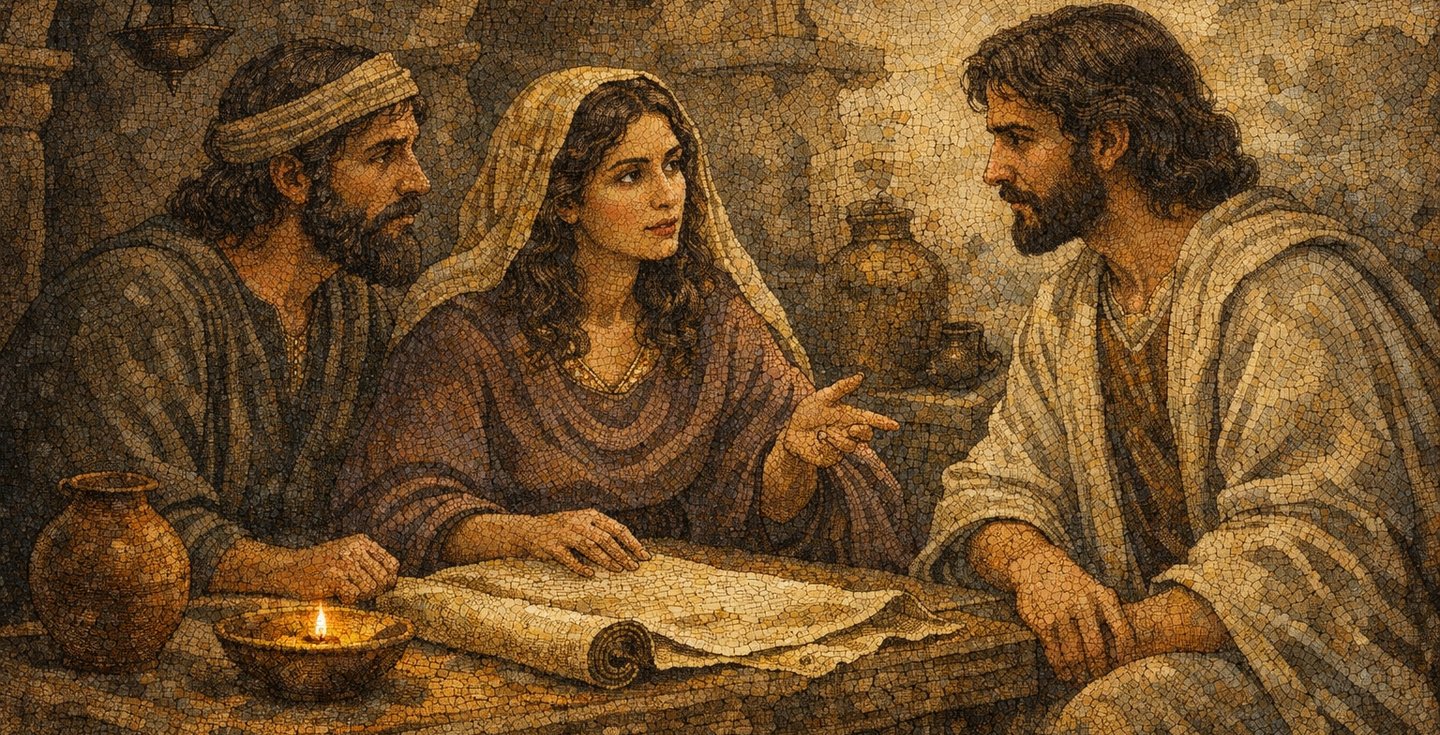
The setup is deceptively simple. A brilliant Alexandrian intellectual named Apollos arrives in Ephesus, eloquent and Scripture-savvy, but knowing "only the baptism of John." A tentmaking couple from Pontus—Priscilla and Aquila—takes him aside and explains "the Way of God more accurately." Shortly after, Paul encounters twelve disciples in Ephesus with the same deficiency, but their resolution requires full rebaptism and dramatic Spirit-manifestation.
Why do these two groups with identical gaps receive such different treatments? Why does Luke emphasize that Apollos is Alexandrian and Aquila is Pontic? And why does Luke never show Paul and Apollos in the same room together?
The answers lie in understanding Luke's narrative strategy: he weaponizes ancient ethnic stereotypes to make a theological point about who possesses genuine authority in the Jesus movement. The "foolish" correct the "wise." The margins instruct the center. And the Spirit, not cultural capital, determines who belongs.
Aquila and Priscilla: Displaced Artisans from the Barbarian Periphery
Claudius's Expulsion and Artisan Networks
Luke introduces Aquila as "a Jew... a native of Pontus" (Ποντικὸν τῷ γένει) who had "recently come from Italy with his wife Priscilla, because Claudius had ordered all Jews to leave Rome" (Acts 18:2). This brief biographical note places the couple at the intersection of imperial policy and economic vulnerability. Claudius's expulsion edict, known from Suetonius and other sources, appears to have been a targeted response to unrest within the Jewish community of Rome—possibly related to disputes over Christ.[1]
The effect is straightforward: Jews like Aquila and Priscilla are forced out of the capital and pushed into other cities of the empire. Luke's reference frames them as diaspora artisans shaped by imperial policy—people whose movements are driven not by missionary zeal alone but by the blunt force of Roman anxiety about unrest.
Paul's decision to stay with them and work at the same trade—tentmaking or leatherworking—signals more than economic pragmatism. It locates the nascent Corinthian community squarely within the world of itinerant artisans, dependent on workshop networks and vulnerable to shifts in civic favor. Manuell's study of Prisca and Aquila underscores that they represent precisely the sort of mobile, adaptable couple through whom the movement often advanced—socially marginal in Roman terms, yet crucial in hosting and sustaining assemblies in key cities.[2]
Pontus: The Barbarian Backwater
To grasp the force of Luke's narrative, modern readers must recover what "Pontic" signaled to ancient audiences. From Herodotus onward, Pontus—the region surrounding the Black Sea in what is now northern Turkey—was stereotyped as the very edge of civilization, home to uneducated and dim-witted barbarians.
Herodotus singled out the peoples of Pontus as "the most unlearned" (ἀμαθέστατα) of all: "For we cannot show that any nation within the region of the Pontus has any cleverness, nor do we know of any notable man born there" (Hist. 4.46).[3] This stereotype persisted for centuries. The satirist Menander wrote simply: "Pontus: thick-witted old men" (Sam. 98).[4] Lucian of Samosata described the inhabitants as "thick-witted" and "uneducated," noting that the charlatan Alexander chose this region precisely because of the assumed stupidity of the locals.[5]
Diogenes Laertius records a joke about a student from Pontus being told to bring "a new book, a new pen, and new tablets, if you have a mind to"—a pun implying he needed to bring brains as well.[6] Philostratus claimed that even if people from Pontus traveled to Athens for education, "their own speech deteriorates from the influence of these barbarians to a greater extent than they can contribute to the improvement of the speech of the newcomers."[7]
Beyond intellectual stereotypes, Pontus was imagined as a harsh, inhospitable wasteland. Tertullian's description epitomizes the prevailing view: "There is sternness also in the climate—never broad daylight, the sun never cheerful, the only air they have is fog, the whole year is winter, every wind that blows is the north wind" (Marc. 1.1).[8] Even Greeks who settled in Pontus were thought to have degenerated into barbarism. Dionysius of Halicarnassus noted that Greeks living among barbarians "have in a short time forgotten all their Greekness," citing specifically "those Achaeans who are settled around Pontus": though "originally Eleans, of a nation the most Greek of any, they are now the most savage of all barbarians" (Ant. rom. 1.89.4).[9]
The stereotype was totalizing: Pontus represented the antithesis of civilization, learning, and cultural refinement. When Luke identifies Aquila as Ποντικὸν τῷ γένει, he activates this entire complex of negative associations.
Apollos: The Alexandrian Intellectual Who Needed Correction
Alexandria's Cultural Capital
Luke's introduction of Apollos as "a Jew, a native of Alexandria" (Ἀλεξανδρεὺς τῷ γένει, Acts 18:24) would have immediately activated powerful associations in an ancient audience. Alexandria was the second city of the Roman Empire, home to the Mouseion and its legendary library, and renowned throughout the Mediterranean world for its philosophical schools and intellectual sophistication.
As Menander Rhetor noted in the third century CE, "the Alexandrians are very proud even nowadays of their grammar, geometry, and philosophy."[10] For a first-century audience, an Alexandrian Jew combined the prestige of Hellenistic paideia with mastery of the Hebrew scriptures—precisely the fusion that Luke emphasizes when he describes Apollos as "eloquent" (ἀνὴρ λόγιος), "well versed in the Scriptures" (δυνατὸς ὢν ἐν ταῖς γραφαῖς), and one who "taught accurately" (ἐδίδασκεν ἀκριβῶς, 18:24-25).[11]
This was the city of Philo, the great Jewish philosopher whose allegorical interpretations sought to demonstrate the harmony between Moses and Plato. This was the intellectual center that exported Greek learning across the empire. An Alexandrian intellectual would rank at the top of any ancient prestige hierarchy.
Formulaic Parallelism: Luke's Deliberate Setup
Luke's introduction of Aquila uses precisely the same syntactical formula as his later introduction of Apollos: τινα Ἰουδαῖον ὀνόματι Ἀκύλαν, Ποντικὸν τῷ γένει (18:2) parallels Ἰουδαῖός τις Ἀπολλῶς ὀνόματι, Ἀλεξανδρεὺς τῷ γένει (18:24). This construction—"a certain Jew by name X, Y-ian by race/ethnicity"—appears nowhere else in Acts with such precision.[12]
The syntactical symmetry invites the reader to compare the two gentilics: Ποντικόν versus Ἀλεξανδρεύς. One evokes barbarism, ignorance, cultural backwardness; the other evokes sophistication, learning, philosophical achievement. The contrast could hardly be sharper. Luke has set the stage for a dramatic reversal.
The Reversal: Pontic Artisans Instruct Alexandrian Scholar
When Luke narrates that Priscilla and Aquila "took [Apollos] aside and explained the Way of God to him more accurately" (προσελάβοντο αὐτὸν καὶ ἀκριβέστερον αὐτῷ ἐξέθεντο τὴν ὁδὸν [τοῦ θεοῦ], 18:26), the scenario would have struck an ancient audience as genuinely astonishing. A manual laborer from Pontus—stereotyped as uneducated and thick-witted—correcting and instructing a learned Alexandrian intellectual? This reverses every cultural expectation embedded in the ethnic identifiers Luke has so carefully deployed.
The shock value increases when we recognize that Aquila and Priscilla were tentmakers (σκηνοποιοί, 18:3)—manual laborers, members of a class generally despised by Greco-Roman elites as "banausic" (servile, degrading). Yet here, the Pontic artisan couple becomes the theological instructor of Alexandria's finest.
Luke has not simply ignored ethnic stereotypes—he has weaponized them for rhetorical effect. By activating negative associations with "Pontic" and positive associations with "Alexandrian," then showing the former teaching the latter, Luke undermines the entire edifice of ethnic-based hierarchy. The manual laborer from the cultural periphery possesses superior knowledge of "the Way of God." The sophisticated Alexandrian requires correction.
Priscilla's Name First: Gender Reversal Compounds Ethnic Reversal
Within that reversal, Priscilla emerges as a particularly destabilizing figure. In Acts 18:2, Luke introduces "Aquila... with his wife Priscilla"—standard ancient ordering with the husband first. But in Acts 18:26, when the couple corrects Apollos, the order flips: "Priscilla and Aquila took him aside."
In a culture where women's names almost never preceded their husbands' in formal contexts, Luke is signaling something. Manuell surveys the evidence and argues that this likely reflects either higher social status, greater prominence in Christian ministry, or both.[13] Ancient sources even described women from the Pontus region as Amazons—warlike, preferring battle to domestic virtue—the exact opposite of the respectable Roman matron.
So Luke gives us a woman from a "barbarian" region, married to a man from that same dismissed backwater, and she's the one leading the instruction of an elite Alexandrian intellectual. The ancient reader's reaction? Disbelief. Maybe offense. Certainly surprise. Luke layers a gender reversal onto the ethnic reversal, compounding the subversion of conventional authority structures.
Theological Resonance: "God Chose What Is Foolish"
The Pontus-Alexandria reversal resonates deeply with Paul's rhetoric in 1 Corinthians, written to address conflicts in the very church where Aquila, Priscilla, and Apollos all ministered. Paul writes: "God chose what is foolish in the world to shame the wise; God chose what is weak in the world to shame the strong; God chose what is low and despised in the world, things that are not, to reduce to nothing things that are" (1 Cor 1:27-28).[14]
Whether or not Luke knew 1 Corinthians, he presents a narrative enactment of the same principle. The "foolish" Pontic (by the world's reckoning) instructs the "wise" Alexandrian. The despised artisan class teaches the cultured intellectual. Luke's narrative logic aligns with Paul's theological argument: in the ἐκκλησία, human wisdom, ethnic pedigree, and social status are radically relativized.
Apollos, Factionalism, and the Corinthian Connection
Teacher-Allegiance in Second Sophistic Culture
1 Corinthians reveals how easily Apollos became a flashpoint for factionalism. Some believers lined up behind him, others behind Paul, others behind Cephas, and still others behind Christ alone (1 Cor 1:10–12). For years, scholars read this as simple immaturity. But more recent work suggests something sociological.
Bruce Winter argued that this setting should be understood within the Second Sophistic world where students fiercely attached themselves to favored orators. An eloquent, Alexandrian figure like Apollos fits this world perfectly. The problem is not that Apollos himself seeks rivals, but that Corinthian hearers map familiar status-driven discipleship onto Christian teachers. "I am of Apollos" becomes a Christianized version of competitive teacher-allegiance.[15]
Timothy Brookins pushed further, arguing that "wisdom" in Corinth functioned as a spiritualized hierarchy—an achievement logic that sorts "mature/spiritual" believers above the "immature." On this view, the engine driving factionalism is not merely rhetorical style but status-by-spiritual-achievement. That helps explain why Paul keeps re-centering "gift," "grace," and the cross: the crisis is achievement versus reception.[16]
Luke's Narrative Diplomacy
Acts, written decades after 1 Corinthians to an audience likely familiar with it, presents a different angle. Luke introduces Apollos as an effective preacher whose only deficiency concerns baptism, corrects that deficiency offstage through Priscilla and Aquila, and then shows Apollos vigorously helping those who had believed through grace (Acts 18:27–28). At no point does Luke narrate a direct meeting between Paul and Apollos, nor does he hint at rivalry.[17]
This choreography matters. Luke is not covering up a personal rivalry so much as cooling a predictable Greco-Roman teacher-allegiance dynamic—the kind of audience-driven status sorting that turns gifted instructors into factional banners. Acts functions as narrative diplomacy. It acknowledges Apollos's independent Alexandrian stream while re-scripting him as corrected, commissioned, and safely "inside the way of God."
The Western text of Acts 18:25 includes a striking variant, stating that Apollos had been instructed in the word "in his homeland"—that is, in Alexandria. If correct, Apollos represents not simply an isolated preacher but the tip of an Alexandrian Christian network shaped by John the Baptist's legacy and local forms of wisdom teaching.[18] Luke's decision to fold this figure into the broader movement via Priscilla and Aquila, while omitting any face-to-face negotiation between Paul and Apollos, reads like careful narrative management of competing streams.
Apollos's Integrity
1 Cor 16:12 presents Apollos as a man of integrity rather than ambition. He refuses to revisit Corinth when his presence would likely exacerbate factionalism, despite Paul's strong urging. Roukema suggests that this refusal may reflect Apollos's determination not to be a pawn in local status games.[19]
Taken together, Acts and 1 Corinthians show Apollos as a complex figure: a product of Alexandrian Jewish culture and Baptist initiation, corrected by a Pontic artisan couple, admired by Corinthian believers, capable of becoming a factional banner, yet committed enough to unity to stay away when his presence would do harm. Luke's portrait is selective but not wholly at odds with Paul's letters; it simply foregrounds harmony and correction where the letters show how fragile that harmony could be.
Ephesian Twelve: Same Deficiency, Different Resolution
Identity Confusion in a Strategic City
When Paul arrives in Ephesus and encounters "some disciples" who have not even heard that there is a Holy Spirit (Acts 19:1–2), Luke presents a community in identity limbo. They are called "disciples," suggesting some kind of allegiance to the Jesus movement, yet their initiation remains tied to John's baptism. In the wake of the Apollos episode, this looks less like an odd anomaly and more like evidence of a Baptist-shaped network stretching through the eastern Mediterranean.
Ephesus itself is a strategic city: a major urban, economic, and cultic hub whose influence in Asia Minor rivals or exceeds that of Antioch and Corinth. For Luke, securing a properly initiated, Spirit-defined community here is vital to the story's unfolding. A group whose baptismal identity remains tethered to John rather than to Jesus and the Spirit cannot serve as the symbolic nucleus of that mission.
John's Baptism as Boundary Problem
Randall Hedlun's sociological analysis reads Acts 18:24–19:7 as a case study in how Luke manages deviant teaching about baptism and its implications for social boundaries.[20] In this reading, Apollos and the Ephesian disciples represent two expressions of a "John's baptism" movement that threatens to perpetuate a Jewish-centered purity map: repentance-focused, oriented toward Israel's hopes, but ambiguous about the status of Gentiles and the role of the Spirit.
Drawing on Berger and Luckmann's concept of a symbolic universe, Hedlun suggests that Luke deploys narrative strategies to bring these deviant strands back under the umbrella of a Gentile-inclusive, Spirit-based order. The Ephesian disciples' ignorance of the Spirit functions as a sign that their current world of meaning is misaligned with the divine order as Luke narrates it.[21]
Re-Baptism and Spirit Reception
Paul's response is uncompromising. He does not simply supply additional information; he re-baptizes the disciples "into the name of the Lord Jesus" (Acts 19:5). This move has significant social weight. It effectively declares that their previous initiation did not place them in the same category as those who belong to the Spirit-formed community. To join that community, they must accept a new marker of belonging that supersedes their earlier Baptist identity.
When Paul lays hands on them and they receive the Holy Spirit, speaking in tongues and prophesying (Acts 19:6), Luke signals that their status has been publicly legitimated. In contested boundary situations—Samaritans in Acts 8, Gentiles in Acts 10, these former John-disciples in Acts 19—tongues and prophecy function not as private spiritual experiences but as visible verdicts that settle the question of who is "in."[22]
Why Different Resolutions?
The puzzle remains: why does Apollos receive private instruction without rebaptism while the Ephesian twelve undergo the full ritual sequence? The answer may lie in Acts 18:25, where Luke describes Apollos as "fervent in spirit" (ζέων τῷ πνεύματι). The NRSV renders this ambiguously, but the Greek more likely means "fervent in the Spirit"—capital S.
If Apollos already possessed the Spirit that the Ephesian disciples lacked, his deficiency was informational rather than ontological. He needed instruction, not initiation. The Ephesian twelve, by contrast, "had not even heard there is a Holy Spirit" (19:2)—a statement that signals not merely ignorance but absence. Their previous baptism did not place them within the Spirit-defined community; therefore, it had to be replaced.
Luke's handling shows a consistent pattern: he acknowledges the existence of competing initiation systems and partial understandings but refuses to demonize the individuals involved. Apollos is fervent and eloquent, not malicious. The Ephesian disciples are called "believers," not heretics. The problem lies in the maps of belonging they inhabit, not in hostility to the truth.
"About Twelve Men": Symbolic Echoes of Reconstituted Israel
Twelve in Luke-Acts
Luke is not casual with the number twelve. In his Gospel, Jesus' choice of twelve apostles is widely recognized as a symbolic act of reconstituting Israel around himself, echoing the twelve tribes.[23] After Judas's death, Acts 1 devotes substantial space to restoring the Twelve, precisely so that the community can face Pentecost with a full symbolic representation of Israel present.
T. M. Christensen has argued that Luke uses the Twelve as a literary device for depicting a restored, eschatological Israel, with the apostles pictured as leaders of "twelve new tribes."[24] Even if individual readers remain cautious about pressing every occurrence of the number, it is clear that Luke has trained his audience to associate "twelve" with the people of God in their reconstituted form.
The "About Twelve" in Ephesus
When Luke concludes the Ephesian disciples scene by noting that "there were about twelve men in all" (Acts 19:7), interpreters face a choice. Some treat the phrase as a simple headcount with no symbolic intent beyond indicating the small size of the group. Others, including Keener, suggest that the number likely recalls the Twelve in Jerusalem, signaling continuity between the original apostolic nucleus and this newly Spirit-formed group in Ephesus.[25]
The wording "about twelve" (ὡσεὶ δώδεκα) guards against over-literalizing the symbol; Luke is not asking readers to imagine a formal Ephesian apostolate. But in a narrative that has already invested "twelve" with heavy symbolic freight, it is difficult to believe that the echo is wholly accidental. The disciples do not just receive the Spirit; they do so in a numerically marked way that resonates with earlier scenes of restored Israel.
Ephesus as New Center of Reconstituted Israel
If the Twelve in Acts 1–2 represent Israel reconstituted around Jesus in Jerusalem, the "about twelve" in Acts 19:7 can be read as a micro-new Israel in Ephesus. They are not apostles, but they become the Spirit-marked nucleus of the community that will make Ephesus a focal point of the mission in Asia Minor.
This reading does not require us to deny that there really were around twelve of them; Luke's interest in symbolic resonance does not cancel his concern for plausible detail. It simply suggests that he chooses to preserve and highlight the number because of its symbolic utility. The Ephesian twelve show that the restored people of God is not a Jerusalem-only phenomenon. Israel's reconstitution continues as the Spirit claims new centers of mission across the empire.
The story that began with twelve Galilean apostles in Jerusalem now includes twelve former Baptist disciples in a major Greco-Roman city. The Spirit that once filled a Jerusalem upper room now fills an Ephesian circle of former outsiders. For Luke's readers, the implication is clear: the reconstituted Israel is no longer tied to a single land or language. It is wherever the name of Jesus, baptism, and the Spirit converge to create a community that reflects the pattern of Acts 2, 10, and 19.
Conclusion: The Margins Instruct the Center
Acts 18:24–19:7 is not an interlude between more dramatic passages. It is a deliberately constructed sequence in which Luke tests the boundaries of the Jesus movement from multiple angles:
Ethnographic: A Pontic artisan couple instructs an Alexandrian intellectual—a scenario that would have shocked ancient audiences familiar with stereotypes of Pontus as the barbarian periphery and Alexandria as the pinnacle of Hellenistic learning. Luke weaponizes these ethnic associations to demonstrate that theological discernment and participation in "the Way" outrank cultural pedigree and educational capital.
Gendered: Priscilla's prominence challenges patriarchal assumptions about who speaks, teaches, and hosts. That a woman is named first in the instructional scene (18:26) compounds the ethnic reversal with a gender reversal.
Ritual: The re-baptism of the Ephesian disciples forces readers to watch how Baptist traditions are renegotiated in light of the Spirit. Same deficiency, different resolutions—depending on what Spirit-presence already exists.
Symbolic: The "about twelve" in Ephesus echoes earlier uses of twelve as a sign of Israel's restoration, signaling that the people of God now have a Spirit-formed nucleus far from Jerusalem.
Luke's strategy is consistent throughout: he subverts status markers—ethnicity, rhetoric, gender, education—by locating authority in discernment and Spirit-shaped practice. The "foolish" Pontic manual laborer corrects the "wise" Alexandrian intellectual. Ethnic stereotypes and educational hierarchies are not erased but radically relativized. The Spirit's presence cannot be predicted or controlled by conventional cultural hierarchies.
For contemporary readers navigating questions of authority, belonging, and who gets to teach whom, Acts 18–19 offers a provocation: the margins often possess what the center lacks. The people everyone dismisses as unteachable may be the ones with the fuller understanding of the Way. And the Spirit, not cultural capital, determines who belongs.
Endnotes
[1] Suetonius, Claudius 25.4; see discussion in Guy Manuell, "Prisca and Aquila: Exemplary Models of Gospel Obedience," Reformed Theological Review 80.3 (2021): 218–41, at 221–22.
[2] Manuell, "Prisca and Aquila," 218–20, 225–27.
[3] Herodotus, Histories 4.46 (trans. A. D. Godley, LCL).
[4] Menander, Samia 98. On the comedic tradition of mocking Pontics, see Matthijs den Dulk, "Aquila and Apollos: Acts 18 in Light of Ancient Ethnic Stereotypes," Journal of Biblical Literature 139 (2020): 177–89, at 184.
[5] Lucian, Alexander 17 (trans. A. M. Harmon, LCL). See den Dulk, "Aquila and Apollos," 184.
[6] Diogenes Laertius, Lives of Eminent Philosophers 6.1.3 (trans. R. D. Hicks, LCL). The pun in Greek relies on the similarity of καινού ("new") and καὶ νοῦ ("a mind as well").
[7] Philostratus, Lives of the Sophists 553 (trans. Wilmer C. Wright, LCL, adapted). See den Dulk, "Aquila and Apollos," 186.
[8] Tertullian, Adversus Marcionem 1.1 (trans. Ernest Evans, 2 vols., OECT; Oxford: Clarendon, 1972), adapted.
[9] Dionysius of Halicarnassus, Roman Antiquities 1.89.4 (trans. Earnest Cary, LCL).
[10] Menander Rhetor, Division of Epideictic Speeches 360.20–24, in Menander Rhetor, ed. and trans. D. A. Russell and Nigel G. Wilson (Oxford: Clarendon, 1981), 60; Riemer Roukema, "The Apostle Paul Meets with Apollos of Alexandria," in Meaningful Meetings with Foreigners in the World of the Bible: Essays in Honour of Klaas Spronk on the Occasion of His Retirement, ed. M. C. A. Korpel and P. Sanders (Leuven: Peeters, 2024), 247–59, at 248–49.
[11] For Alexandria's reputation as a center of learning and the symbolic capital of Alexandrian identity, see Edward J. Watts, City and School in Late Antique Athens and Alexandria, Transformation of the Classical Heritage 41 (Berkeley: University of California Press, 2006), 143–68.
[12] Den Dulk, "Aquila and Apollos," 178. Den Dulk notes that the parallel syntactical construction and the use of τῷ γένει in both passages "strongly suggests a connection between the two formulations and invites the reader to ponder the one thing that differentiates the two formulations apart from the names: the gentilics Alexandrian (Ἀλεξανδρεύς) and Pontic (Ποντικός)."
[13] Manuell, "Prisca and Aquila," 233–40.
[14] On the connection between Acts 18 and Paul's rhetoric in 1 Corinthians about wisdom, foolishness, and status reversal, see den Dulk, "Aquila and Apollos," 188–89.
[15] Bruce W. Winter, After Paul Left Corinth: The Influence of Secular Ethics and Social Change (Grand Rapids: Eerdmans, 2001), 35–64.
[16] Timothy A. Brookins, Rediscovering the Wisdom of the Corinthians: Paul, Stoicism, and Spiritual Hierarchy (Grand Rapids: Eerdmans, 2024).
[17] Roukema, "Apostle Paul Meets with Apollos," 247–53.
[18] Roukema, "Apostle Paul Meets with Apollos," 249–51.
[19] Roukema, "Apostle Paul Meets with Apollos," 256–58.
[20] Randall J. Hedlun, "A New Reading of Acts 18:24–19:7: Understanding the Ephesian Disciples as Social Conflict," Religion & Theology 17 (2010): 40–60, at 40–46.
[21] Hedlun, "New Reading," 50–52; Peter L. Berger and Thomas Luckmann, The Social Construction of Reality: A Treatise in the Sociology of Knowledge (Garden City, NY: Doubleday, 1967), 96–99.
[22] Ben Witherington III, The Acts of the Apostles: A Socio-Rhetorical Commentary (Grand Rapids: Eerdmans, 1998), 568–74.
[23] Richard Bauckham, Jesus and the Eyewitnesses: The Gospels as Eyewitness Testimony, 2nd ed. (Grand Rapids: Eerdmans, 2017), 111–18.
[24] T. M. Christensen, "The Twelve Apostles as Leaders of the Twelve Tribes: Symbolic Reconstitution of Israel in Luke–Acts," New Testament Studies 67 (2021): 201–20.
[25] Craig S. Keener, Acts: An Exegetical Commentary: Acts 15:1-23:35 vol. 3 (Grand Rapids: Baker Academic, 2014), 2863–66.

